Stand with Students
Student Voices Matter. School Leaders Must Protect the Young People Brave Enough to Raise Them.
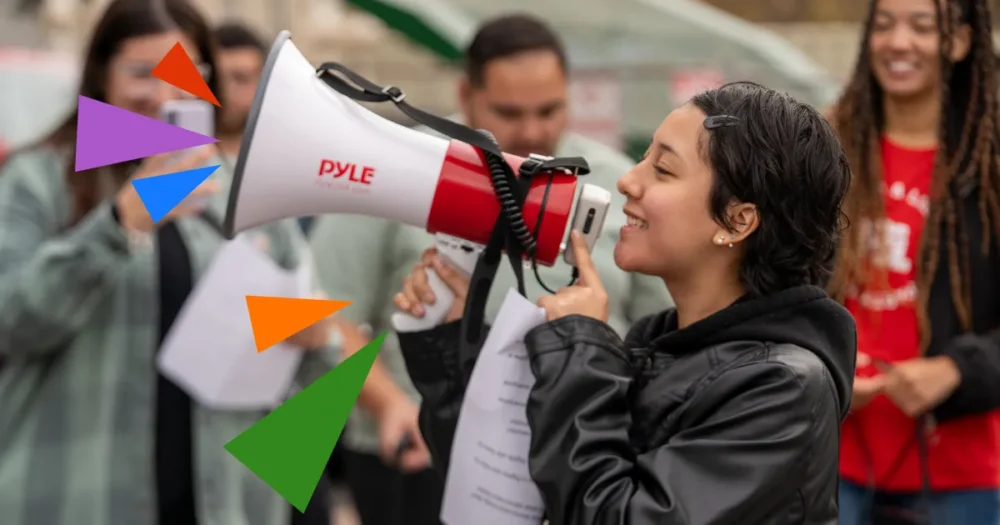
Student Voices Matter. School Leaders Must Protect the Young People Brave Enough to Raise Them.
Schools across the country have been severely disrupted by federal immigration enforcement. In response, students are exercising their power by organizing mass walkouts to disrupt business-as-usual in order to bring attention to their demands.
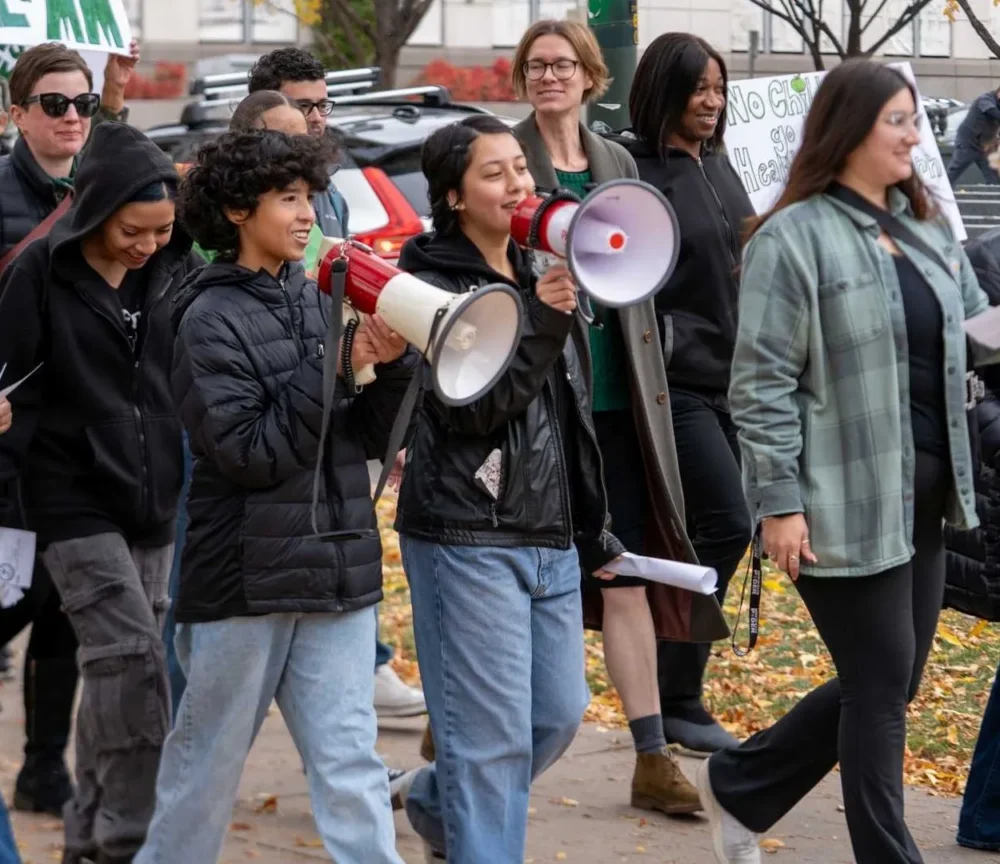
While some politicians are working to limit students’ right to protest and threatening those who dare to speak out against injustice, school leaders can choose to support the safety and dignity of students using their voices to protect their communities and make schools safe and inclusive for all.
Photo courtesy of Movimiento PoderSchool leaders have a choice: Will you stand on the side of those who would threaten young people for practicing meaningful and effective civic engagement in the name of unjust government action? Or will you support your students using their voice to protect their communities and make schools safe and inclusive for all?
Resources to get involved!
This information is not intended to be legal advice. If you have an individual question or issue please consult with an attorney.
The First Amendment generally protects your right to protest (i.e., peacefully assemble). Even when you’re on school grounds, you still have this right as long as you don’t disrupt the functioning of the school.
Yes, you can because schools generally have the right to make rules about student attendance and limit things that happen at school. Depending on what the rules are in your school, the school could impose consequences for missing class or school. This can be anything from marking your absence as “unexcused” in your record, to calling your parent/guardian, or a suspension. In many states, police or truancy officers can also arrest or fine a student for skipping school.
Some schools have exceptions to this rule for peaceful student protests. For example, when students planned walkouts after the 2018 school shooting in Parkland, FL, many superintendents or principals allowed students to participate in the walkouts without consequence. However, since then some school boards have moved to require principals and superintendents to punish students for peacefully protesting during school.
Your school may claim that a protest disrupted school or caused a disturbance, which could lead to a suspension or arrest depending on state law. The First Amendment protects your right to speech in school but only as long as you don’t disrupt the orderly function of a school. Also, the school cannot punish you more harshly than someone who skipped school for a different, nonpolitical reason. That would be unfair and would violate your rights.
If you are disciplined for participating in a walkout, you should read your school’s rules or code of conduct closely to find out what your rights are. You can typically find these rules in your student handbook or on the website for your school or school district. Depending on your school’s policy, your parent/guardian may be able to request that your absence be excused. You also may be able to request a restorative practice, conference, or other meeting with school officials and talk about the importance of student activism during the meeting. You may want to tell school officials your reasons for participating in the protest and the how protests and other forms of civic engagement are important to learning.
You should look at your student code of conduct to find out what the consequences are for missing school. You can typically find the code of conduct in your student handbook or on the website for your school or school district. You should also see if any school or district officials have made a public statement about student protests related to the issue that the walkout was about (e.g., school shootings, police violence, or international conflicts/genocide). Talk with your parent/guardian or family members to see if any special announcements have been made in school newsletters or other platforms.
Dear [Superintendent/Principal Name, School Board or Recipient],
As a concerned [parent/guardian] of a child attending a school in the [School District Name], I urge you to commit to supporting student free speech on school grounds.
School is a place for our students to grow and learn about the world around them. As educators entrusted with preparing young people to lead and to participate fully in our democracy, school leaders have a responsibility not just to teach civic values, but to practice them. Civic engagement is not a lesson confined to textbooks but rather, it is lived, often bravely, by students who speak out against injustice. I call on you as a school leader to protect young people who are organizing and participating in school walkouts, and to affirm that their voices matter.
This country has a rich history of youth protests: in the 1960’s, young people coordinated sit-ins that confronted racial violence and demanded an end to segregation, wore armbands in mass demonstrations calling for an end to the Vietnam War, and in more recent years, organized marches to call for gun reform. Today, in protest of violent ICE raids and abuse from federal and state agents, students across the country are organizing walkouts: one of the most powerful actions students can take to bring attention to their demands for those in power.
In support of students who want to organize walkouts or other student protests, I call on you to take any action in your power to support the adoption and publication of a “Campus Free Speech” policy for [School District Name]. Such policy should, at minimum:
By adopting this policy, [District] will clearly support students’ ability to practice safe and peaceful advocacy and civic engagement.
I ask that you support the addition of this matter to the agenda of the next school board meeting, and that the board engage students, families, and school staff in transparently developing a Campus Free Speech policy.
Thank you for your attention to this matter. I hope you will stand with our family and your students as they become our future leaders and world changers.
Sincerely,
[Name]
[Role in community – Parent/guardian of students at [School name], community member, etc.]
This Principal’s Pledge can help principals and administrators commit to protecting student free speech by pledging to not penalize students for organizing or participating in walkouts or other forms of protest.
If your school district has not yet publicly supported or actively protected students’ ability to organize and speak up, this Principal’s Pledge presents the opportunity to take a stand and be a model for your peers across the school district. District leaders across the country are already doing the right thing and exercising discretion to not penalize students participating in protests and implementing protocols to ensure student safety during walkouts.
Take the pledge below to commit to making your school a safe place where all students can thrive, grow, and learn without fear of discipline for participating in school walkouts.
Student-led demonstrations have always been critical to social change in the U.S.
16-year-old Barbara Johns led a student strike to protest inadequate conditions at the segregated Robert Russa Moton High School. This protest paved the way for the legal challenge that would become part of the landmark Brown v. Board of Education decision.
Over 1,000 students skipped school to march to downtown Birmingham, Alabama demanding an end to segregation in the Children’s Crusade. Hundreds of students, ages 7-18, were arrested and images of children being assaulted by police with clubs, dogs and fire hoses sparked international outrage and led to the passage of the Civil Rights Act.
3,500 Philadelphia students walked out of school and marched to the Board of Education demanding the teaching of African-American history, the right to wear African dress, more Black teachers and administrators, and the renaming of predominately African-American schools after Black leaders. Students were confronted by two busloads of police, who were instructed by Police Commissioner Frank Rizzo to “get their Black asses.”
15,000 students walked out of classes during the Eastside Blowouts in Los Angeles protesting racist school policies that denied Mexican-American students an equal opportunity for an education. Students demanded culturally-relevant curriculum, more Mexican-American educators, and bilingual education. Students were beaten by helmeted police wielding night sticks.
Students wore armbands in mass demonstrations calling for an end to the Vietnam War leading to the landmark Supreme Court decision Tinker v. Des Moines that guaranteed students’ rights to free speech in public schools.
Black students staged a citywide strike of Boston Public Schools after English High School suspended five Black students on charges of damaging school property. The Black Student Federation called for a system-wide boycott of the Boston Public Schools, demanding Black community control, culturally-relevant curriculum, more Black educators, and recognition of Black student unions. The Black Student Federation also called for the removal of police from schools.
Hundreds of protests were organized across the country during A Day Without Immigrants in response to anti-immigrant legislation. Students walked out of school in solidarity with immigrant communities and workers on strike. The bill ultimately failed in the Senate.
Students organized mass walkouts demanding an end to gun violence in response to the mass shooting at Marjory Stoneman Douglas High School in Parkland, Florida. Many superintendents and principals announced that students can participate in the walkouts without disciplinary or legal consequences.
In one of the largest climate mobilizations in US history, youth-led climate groups organized student strikes in all 50 states, DC, and Puerto Rico as part of the Global Climate Strike. New York and Boston public schools gave students permission to participate, while other school districts excused absences for participation.
Thousands of students across the country have been walking out of their schools to protest ICE in their communities, including a national day of action on January 30.
Join our movement to protect student protest